
It has long been the misfortune of metaphysics to speak of “being” in terms so hopelessly discrete that one wonders whether its practitioners have ever encountered a continuous structure. The intellectual habit of carving the world into substances, essences, and identities betrays a conceptual provincialism: a failure to appreciate that the architecture of reality is not a collection of points, but a field; not a set, but a topology; not a catalogue of entities, but a dynamic of relations.
The present treatise begins from a premise that is, in mathematical terms, almost embarrassingly elementary: that relation is not an operation performed upon pre‑existing objects, but the very condition under which objects may be said to exist. In topological language, entities are not “points” but local condensations of relational density within a field whose continuity precedes any attempt at discretisation.
One might say — with apologies to the more delicate reader — that traditional ontology commits the metaphysical analogue of confusing a chart with a manifold. It mistakes the coordinate description for the underlying structure. The I, the world, and the rupture between them are not three objects, but three stable configurations of a single relational manifold, each representing a distinct mode of curvature within the field.
This is not metaphor. It is metaphysical geometry.
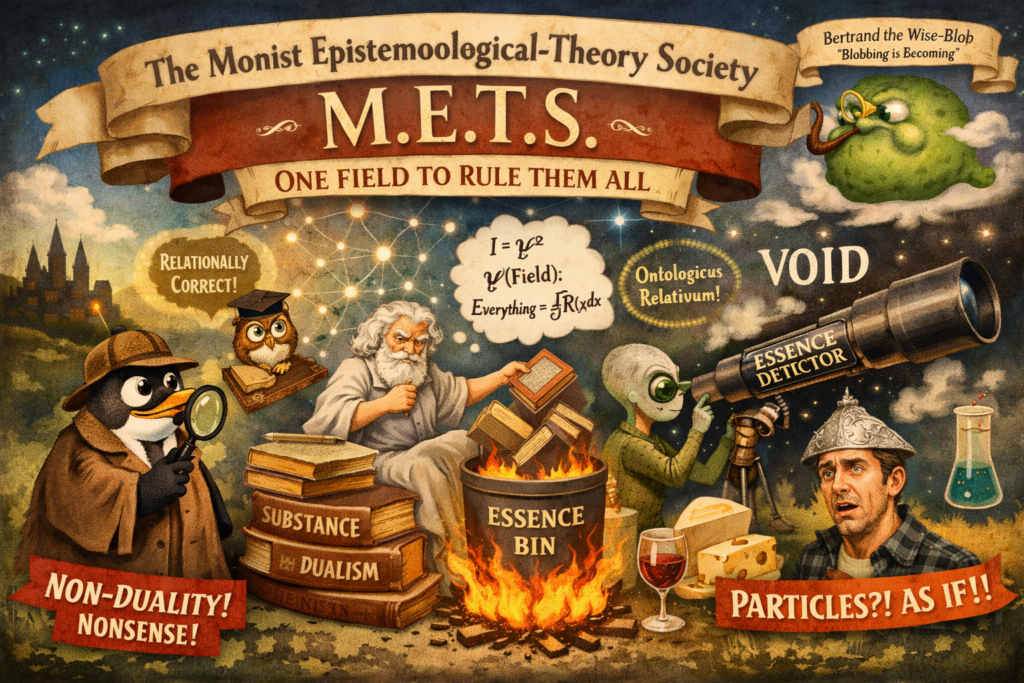
The relational field, as understood here, is not a physical field in the sense familiar from Maxwell or Yang–Mills, though the analogy is instructive. It is a structural field, defined not by forces but by intensities of relational possibility. The “condensation of the I” corresponds to a local increase in relational curvature; the “world” is the global topology of the field; the “rupture” is the necessary discontinuity that allows local structures to differentiate without collapsing into trivial homogeneity.
One finds faint anticipations of this view in Spinoza’s modes, in Leibniz’s expressive monads, and in Whitehead’s occasions of experience — but none of these thinkers possessed the mathematical vocabulary required to articulate the full implications. Their insights remained gestural. They lacked the conceptual machinery of modern topology, differential geometry, and field theory, without which relational monism cannot be properly understood.
For example, consider the notion of continuity. In classical metaphysics, continuity is treated as a property of space or time. In relational monism, continuity is a property of relation itself. The field is continuous not because it occupies a continuous space, but because relation is intrinsically non‑discrete. Entities appear discrete only because the mind, like a careless student of topology, mistakes local charts for global structure.
Similarly, the concept of rupture must be rescued from its sentimental connotations. Rupture is not a wound in the field, nor a tragic separation between subject and world. It is a structural necessity, analogous to the singularities that permit curvature to manifest. Without rupture, the field would be a trivial, flat manifold — metaphysically uninteresting and incapable of supporting differentiation. Rupture is the condition of form.
One must forgive, I trust, the occasional severity of tone. Precision demands it. The contemporary philosophical landscape is regrettably tolerant of conceptual laxity, particularly among those who speak of “pluralism” as though the multiplication of categories were a sign of intellectual sophistication rather than a failure to recognise the unity of the underlying field. The present work declines to indulge such confusions.
Relational monism is offered not as a doctrine to be believed, but as a formal model — a metaphysical topology — through which the structure of experience may be understood with greater clarity. It restores to ontology a certain mathematical elegance, long absent from the discipline, and invites the reader to consider that the world is not made of things, but of relations; not of points, but of fields; not of substances, but of curvatures in the manifold of being.
Whether one accepts this model is, of course, a matter of temperament. But one hopes that the present work will encourage a more disciplined conversation — one worthy of the mathematical imagination and of the relational field to which it aspires to give form.
Leave a Reply